
If You Are Retired or Every Want to Be — Pay Attention!
For months, the resilience of the American consumer has been one of the strongest arguments supporting optimism about the U.S. economy. Despite elevated prices, high borrowing costs and persistent inflation, Americans continued to spend.
But the latest economic data are beginning to reveal increasing financial strain beneath the surface.
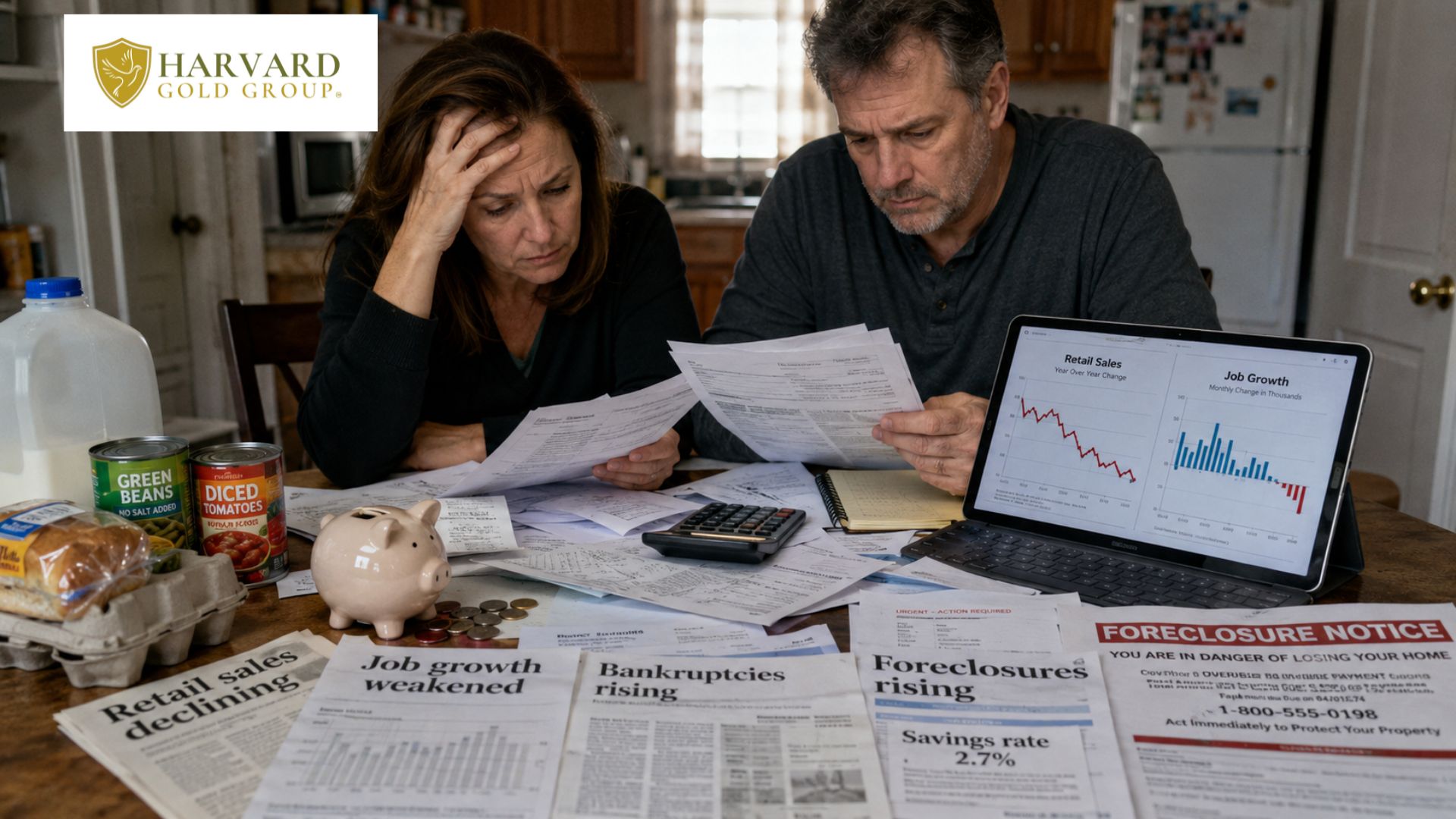
Retail sales have declined, job growth has weakened, bankruptcies and foreclosures are rising, household debt is approaching $19 trillion, and Americans are saving just 2.7% of their disposable income.
None of these indicators, individually, suggests that the U.S. economy is on the verge of collapse. Taken together, however, they paint a more concerning picture—particularly for Americans approaching or already in retirement who may have less time to recover from a significant economic or market downturn.
Consumer Spending Shows Signs of Weakening
Consumer spending has remained a critical pillar of U.S. economic growth, even as households faced rising grocery bills, expensive credit-card debt and some of the highest borrowing costs in years.
That resilience showed its first significant crack in July.
U.S. retail and food-service sales declined 0.6%, marking the first monthly decline in nine months and the largest decline in 14 months. A narrower measure commonly used by economists to estimate consumer spending within gross domestic product also fell 0.4%.
A single month of weaker retail sales does not establish an economic downturn. But the decline becomes more significant when viewed alongside mounting household debt and diminishing savings.
Household Debt Nears $18.8 Trillion
American households ended the second quarter carrying approximately $18.77 trillion in total debt, according to data from the Federal Reserve Bank of New York.
Credit-card balances reached approximately $1.26 trillion, while auto-loan balances climbed above $1.7 trillion.
Combined, Americans now owe nearly $3 trillion on credit cards and vehicles alone.
That raises an increasingly important question about the strength of consumer spending. The issue is no longer simply whether Americans are continuing to spend, but how that spending is being financed.
There is a meaningful difference between consumption supported by rising income and spending supported by dwindling savings, credit cards and additional borrowing.
As household financial cushions shrink, the ability to maintain current spending levels may become increasingly difficult.
Bankruptcy Filings Continue to Rise
Evidence of that strain is already appearing in U.S. bankruptcy courts.
Bankruptcy filings increased 12.2% during the 12 months ending June 30, 2026, with more than 608,000 cases filed.
Individual bankruptcies increased approximately 12%, while business bankruptcies rose nearly 17%.
Unlike consumer-confidence surveys, these figures represent actual court filings and provide a tangible indication that a growing number of households and businesses are reaching the point where their existing financial obligations are no longer sustainable.
Foreclosure Activity Is Moving Higher
Housing is also beginning to show signs of additional pressure.
More than 227,000 U.S. properties received foreclosure filings during the first six months of 2026, approximately 21% more than during the same period a year earlier.
Foreclosure starts increased roughly 18%, while completed bank repossessions jumped approximately 33%.
Current conditions remain far removed from the nationwide housing collapse experienced during the 2008 financial crisis. Nevertheless, rising foreclosure activity deserves attention when it is occurring alongside record household debt, high borrowing costs and historically low savings rates.
Americans Have Little Savings Cushion Remaining
One of the more troubling indicators may be the personal savings rate.
Americans saved just 2.7% of disposable personal income in June, down from 3.5% in March.
For many households, that leaves relatively little room to absorb an unexpected financial expense.
A major vehicle repair, medical bill, increase in insurance premiums, home repair or temporary interruption in employment can quickly become additional credit-card debt when savings are unavailable.
For retirees and those nearing retirement, rebuilding depleted savings can be particularly difficult. Once regular employment income ends, households may have fewer opportunities to recover from large financial setbacks.
Inflation Slowed, But Prices Never Returned to Previous Levels
Inflation has also complicated household finances.
Although the rate of inflation has fallen significantly from its previous highs, lower inflation does not mean prices have returned to earlier levels. It simply means prices are generally increasing at a slower pace.
Consumer prices were still 3.4% higher in July than one year earlier. Food prices were approximately 3% higher, while energy prices were nearly 15% higher.
Average hourly earnings, meanwhile, increased approximately 3.2%.
For many households, wage growth is therefore barely keeping pace with the continuing increase in living expenses.
The impact can be even more noticeable for retirees relying primarily on Social Security, pensions and accumulated savings. Higher prices for groceries, insurance, utilities, healthcare, property taxes and travel steadily erode the purchasing power of fixed income and retirement assets.
That loss of purchasing power can become increasingly difficult to recover as retirement progresses.
July Jobs Report Adds Another Warning
Weakening employment data have added another layer of concern.
The U.S. economy lost 23,000 payroll jobs in July.
At the same time, previous employment estimates for May and June were revised downward by a combined 103,000 jobs.
In effect, more than 100,000 jobs that had previously been reported as created disappeared from the government's updated estimates.
The unemployment rate remains relatively low at 4.1%, meaning the United States is not currently experiencing a severe employment crisis.
The trend, however, has weakened.
Over the previous 12 months, employers added an average of only about 34,000 jobs per month.
That matters because consumer spending ultimately depends on income. Households can temporarily maintain spending by drawing down savings, carrying balances on credit cards, financing vehicles or using services such as buy now, pay later.
Those strategies cannot substitute indefinitely for steady income growth.
If employment conditions deteriorate while households are already highly leveraged and saving very little, consumer weakness could accelerate.
A K-Shaped Economy Can Hide Financial Stress
Another factor complicating the economic picture is the growing divide between different groups of American consumers.
A wealthy household with significant investment assets, strong home equity and relatively little debt may continue to benefit from rising financial markets and elevated property values. Those households can continue traveling, dining out and spending heavily.
At the same time, another household may rely largely on wages, Social Security or fixed retirement income while absorbing rising costs for food, insurance, electricity and healthcare.
Both households are part of the same economy, but their financial experiences can be dramatically different.
Recent research has suggested that the wealthiest Americans account for an unusually large percentage of total consumer spending. That can make overall spending figures appear healthier even while millions of lower- and middle-income households experience increasing financial pressure.
As a result, the headline that "consumers are still spending" may conceal significant weakness beneath the aggregate numbers.
Why the Risks Are Different for Retirement Investors
These economic developments may be particularly important for Americans in their 60s and 70s.
A younger investor who experiences a severe stock-market decline may have decades of continued employment and investment contributions available to rebuild wealth.
Someone approaching retirement does not necessarily have that advantage.
A significant market decline near the beginning of retirement can create what financial planners call sequence-of-returns risk. If retirees are forced to withdraw money from investments after prices have fallen, they may have to sell a greater number of shares to generate the same income.
Those shares are then unavailable to participate in a future market recovery.
For investors approaching retirement, risk management therefore becomes about more than maximizing potential returns. It also involves determining how much exposure to financial-market volatility is appropriate when the time available to recover from losses has shortened.
Multiple Warning Signs Are Appearing Together
The concern is not any single economic statistic. It is the number of warning signs now moving in the same direction.
Retail sales declined 0.6%. Household debt has reached nearly $18.8 trillion. Credit-card balances exceed $1.2 trillion. Bankruptcy filings are up 12.2%. First-half foreclosure filings increased 21%. The personal savings rate has fallen to 2.7%. Inflation remains elevated, energy prices have risen sharply, payroll employment declined in July, and previous employment estimates were revised downward by another 103,000 jobs.
None of those figures guarantees that a recession, financial crisis or market decline is imminent.
But periods of economic deterioration rarely begin with a single definitive signal. Financial stress typically accumulates gradually before becoming visible in headline economic data.
For investors approaching retirement, waiting until a downturn becomes obvious can leave fewer opportunities to adjust.
Where Physical Gold and Silver May Fit
Periods of rising debt, persistent inflation and financial-market uncertainty have historically increased interest in physical gold and silver.
Precious metals differ from many conventional financial assets because they are not dependent on a corporation's promise to pay, a borrower's ability to repay a loan or the creditworthiness of a financial institution.
Physical gold and silver also cannot be created in unlimited quantities through monetary policy.
Like every asset, precious metals can rise and fall in value, and ownership does not eliminate investment risk. However, for investors concerned about inflation, declining purchasing power, rising government and consumer debt, or broader financial-market instability, physical precious metals may provide an additional source of diversification.
The objective does not necessarily have to be abandoning stocks, bonds or cash.
Instead, investors may want to consider whether their entire retirement portfolio should depend on the same financial system and economic conditions simultaneously.
For Americans in or approaching retirement, that question can become increasingly important.
The Headlines Often Arrive After the Turning Point
Major economic turning points rarely begin with an announcement that a crisis has officially started.
More often, the warning signs develop gradually.
Debt rises. Savings decline. Delinquencies increase. Bankruptcies climb. Consumers begin pulling back. Hiring slows.
Eventually, financial markets and the broader media recognize what has already been developing underneath the surface.
The U.S. economy is not collapsing today. But financial pressures that were previously obscured by strong consumer spending are becoming increasingly difficult to ignore.
For Americans approaching retirement or already living on savings accumulated over a lifetime, the goal is not to predict the exact timing of the next recession or market decline.
It is to recognize when economic risks are increasing and prepare before those risks become impossible to ignore.
You do not have to know exactly when the cycle will turn. You only have to recognize that it is already moving—and prepare accordingly.
Harvard Gold Group helps Americans understand how physical gold and silver can fit into a diversified retirement strategy through direct ownership or a Precious Metals IRA.
For investors increasingly focused on protecting the purchasing power of their retirement savings rather than simply chasing the next market high, this may be an appropriate time to understand the options available.
Stay informed, stay grounded and hold gold.
Story by Harvard Gold Group
Educational Note: This material is provided for general educational purposes and is not individualized investment, tax or legal advice. Precious-metals prices can rise or fall, and investors should consider their own objectives and circumstances before making a purchase.