Imagine two people buying gold on the same morning. One is trading a contract they may sell before lunch. The other is choosing gold coins to hold for years and perhaps leave to their children.
Both will watch the gold price. But what they own, what it costs, and what a price drop means for them can be very different.
That distinction gets lost in the daily headlines. For anyone considering physical gold, understanding it can make the market much easier to follow.
What the latest buying figures reveal
The World Gold Council’s report released November 3, 2026, shows how different parts of the gold market can move in different directions. From July through September, worldwide demand for gold bars and coins was 19% lower than a year earlier. During that same period, funds backed by physical gold added more than 211 metric tons to their holdings. [1]
There was another wrinkle. Despite that slower quarter, worldwide bar and coin demand for the first nine months of 2026 was the strongest for that period since 2013. Yet U.S. bar and coin demand during the third quarter was down 40% from a year earlier. [1]
A strong start to the year, a quieter recent quarter, and different buying patterns across countries can all exist together. A headline about “gold demand” needs that context.
What happens in the futures market
A standard COMEX gold futures contract is an agreement to buy or sell a set amount of gold for future delivery at an agreed price. Businesses use futures to manage changing prices. Traders also use them to try to profit from price movements. [2, 4]
Futures traders put up a deposit called margin, which can be much smaller than the value of the gold covered by the contract. That deposit does not give them ownership of the metal. If the market moves against them, they may have to add money quickly or have their position closed. [3]
These contracts can lead to physical delivery under the exchange’s rules. Many traders, however, close their positions before delivery. [2, 4]
Futures and physical gold are connected markets. Delivery provisions help keep futures prices tied to cash prices. A move in the futures market can therefore matter to someone who owns coins, even though that person never trades a contract. [2]
What owning physical gold changes
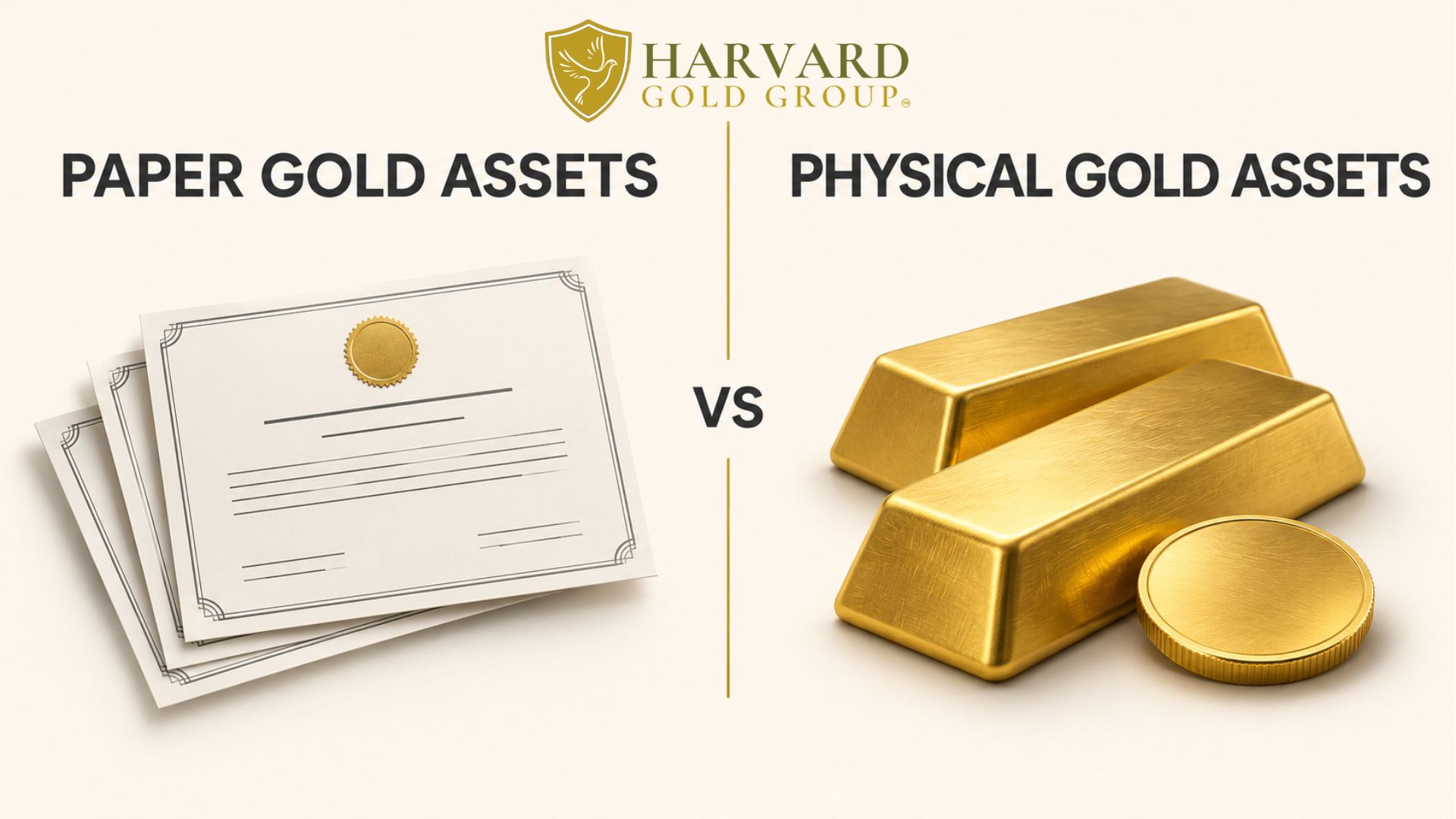
With physical gold, you are buying actual coins or bars. Once they are fully paid for and held without borrowing, you have no futures contract to expire and no futures margin call to meet when gold falls. [3, 4]
That gives ownership a different rhythm. You may have bought gold to add a tangible asset to your savings, keep it for years, or eventually pass it to your children. A trader’s decision to sell before lunch or 90 days from then does not automatically change your purpose.
The metal still has a changing dollar value. A one-ounce gold coin still contains the same amount of gold after a price decline, but it may bring fewer dollars when sold. Physical ownership gives you the metal.
Why paper gold needs a closer look
“Paper gold” is a broad nickname for financial products linked to gold. Those products are not all alike. A share does not equal an ounce of gold.
Some exchange-traded funds, or ETFs, hold actual gold bars in an account that has third party counter risk, and most ETFs do not allow you to have the choice to take possession of your gold. Their shares trade through a brokerage account. You own fund shares, with rights defined by the fund’s terms, rather than coins delivered to you. [5]
For example, SPDR Gold Trust holds bullion, but its trustee handles exchanges of shares for gold through authorized firms in large blocks. Individual shareholders cannot redeem shares directly with the trustee for physical gold. [5]
The useful question is: What exactly do I own, and how can I access or sell it? That question helps you compare a fund share, a futures contract, and physical gold.
Why the price of a coin can differ from the headline
The spot price is a market reference for gold available for immediate delivery, usually quoted per troy ounce. A finished coin or bar generally costs more. The additional amount is called a premium. [7]
A coin must be made and distributed before it reaches you. The U.S. Mint explains that its bullion coin prices include a premium to cover those costs. Demand and availability for a particular product can also affect its price. [6, 9]
Consider this hypothetical example for the same coin containing one troy ounce of gold:
| Price component | First quote | Later quote |
| Gold value at spot | $4,000 | $3,900 |
| Product premium | $200 | $250 |
| Total before any tax or separate fees | $4,200 | $4,150 |
Illustration only. These are not current market prices or HGG quotes.
Here, gold’s spot price fell $100, but the coin’s price fell only $50 because its premium rose. Premiums can also fall. The final price depends on both parts.
Availability deserves the same careful reading. A delay for one popular coin can reflect production or distribution limits. By itself, it does not establish a shortage across the entire gold market. [9]
Look at Gold’s Strength Over Time
Gold’s long-term record gives us a broader perspective than a single day’s price change. For people thinking about retirement savings or something to leave their children, that history deserves attention.
In its 2026 review, the World Gold Council reported that gold’s U.S. dollar price had grown at an annualized rate of approximately 9% from 1971 through 2025. That measures growth across the full period, rather than a steady gain each year. Gold also outpaced U.S. inflation over that time.
More recent comparisons make that growth easy to picture. Gold’s average annual price was approximately $279 an ounce in 2000, $1,770 in 2020, and $3,432 in 2025. The 2025 average was more than twelve times its 2000 level and nearly double its 2020 level. Those figures show why the longer view matters.
For a physical gold owner, that perspective brings the purpose of ownership into focus. You can hold actual coins and bars as part of your savings, keep them for future needs, or plan to pass them to your children. Their role in your life can extend well beyond the next market headline.
Understanding your purchase price, storage arrangements, and eventual resale options helps you make those plans thoughtfully. With clear information from the beginning, you can consider physical gold in the context of the years ahead and what matters most to you and your family.
These historical market-price figures are before ownership costs and do not guarantee future results.
Understanding your choices with Harvard Gold Group
At HGG, we help you understand the physical metals you are considering, their total cost, and how our buyback program works.
HGG is the first gold dealer in America to offer customers the more “expensive” specialty coins at the same low range cost available for bullion coins. Don’t pay more for numismatic, semi numismatic, or collector coins.
We offer free consultations, transparent costs, metals overviews, lifetime account support for clients and their heirs, and a straightforward buyback program. You receive direct assistance from our co-owners, with no commissioned salespeople or bonused managers.
Have questions about physical gold, direct delivery, or Precious Metals IRAs?
Contact Harvard Gold Group for a free consultation. No pressure.
Story by Harvard Gold Group
Educational Note: This material is provided for general educational purposes and is not individualized investment, tax or legal advice. Precious-metals prices can rise or fall, and investors should consider their own objectives and circumstances before making a purchase.