

U.S. Bonds Are Not Risk Free —
If They Were, the Market Could Stand on Its Own
This "risk-free" status is a carefully managed illusion
When Safety Is Engineered, True Protection Must Be Chosen
For decades, the bedrock of global finance has been the unchallenged belief that the U.S. Treasury Bond is the "safest investment in the world." This claim is recited by policymakers and financial experts as an article of faith. Yet, when we look beneath the surface at the extraordinary actions taken by the Federal Reserve (the Fed) since the 2008 financial crisis, the truth becomes impossible to ignore: the U.S. bond market is no longer a self-sustaining entity; it is a market that requires continuous life support from the very government whose debt it sells.
The simple fact that the Fed has had to become the largest single holder and purchaser of U.S. sovereign debt completely nullifies the idea of it being a purely "risk-free" asset.
The Crisis That Required The Government to Create a New Buyer: The Fed’s Quantitative Easing
The Federal Reserve’s necessary involvement in the U.S. bond market didn’t happen by choice— it happened because the system was breaking. By late 2008, the Fed had already used up its traditional tool of cutting short-term interest rates, pushing them all the way down to zero. Yet the financial system continued to unravel. Credit markets froze. Liquidity vanished. Confidence collapsed.
So the Fed crossed into emergency territory.
It launched Quantitative Easing (QE)— a direct intervention in which the Fed began creating trillions of dollars out of thin air to purchase U.S. Treasury bonds and Mortgage-Backed Securities (MBS).

This was not the “free market” in action. This was the government becoming the market.
Eighteen years later, in 2025, the Federal Reserve STILL remains the single largest holder of U.S. Treasury debt.
The Proof is in the Balance Sheet: Artificial Demand and Manipulation
The clearest sign of this market dependency is the dramatic expansion of the Federal Reserve's (Fed) balance sheet— the bank account of the U.S. central bank.
- Before 2008: The Fed's balance sheet was modest, holding under $1 trillion in assets.
- The 2008 Financial Crisis Response (QE): To stabilize the system, the Fed injected massive amounts of money, growing its balance sheet to a peak of about $4.5 trillion over several years. This was an unprecedented 4.5x increase.
- The 2020 Pandemic Response (QE): The Fed's response in 2020 was much larger and faster. It injected trillions of dollars in just months, causing the balance sheet to nearly double again, ultimately peaking at close to $9 trillion.
The 2022 Bond Market Wipeout
The “Safest” Investment Just Lost Trillions. If you owned bonds in 2022, you didn’t just lose a little— you witnessed the worst bond collapse in modern history.
- 10-year Treasuries: down -17%
- 20-year bonds: down -30%
- 30-year Treasuries: down a devastating -39%
That means a “safe” $500,000 retirement portfolio could have lost $150,000–$200,000 in a single year— without ever touching the stock market. And the same forces behind that crash— runaway debt, artificial demand, and Fed intervention— are still in play today. Every new round of Federal Reserve “rescue” quietly steals from your future purchasing power.
Bonds Broke the Banks— Creating The 2023 Regional Banking Crisis
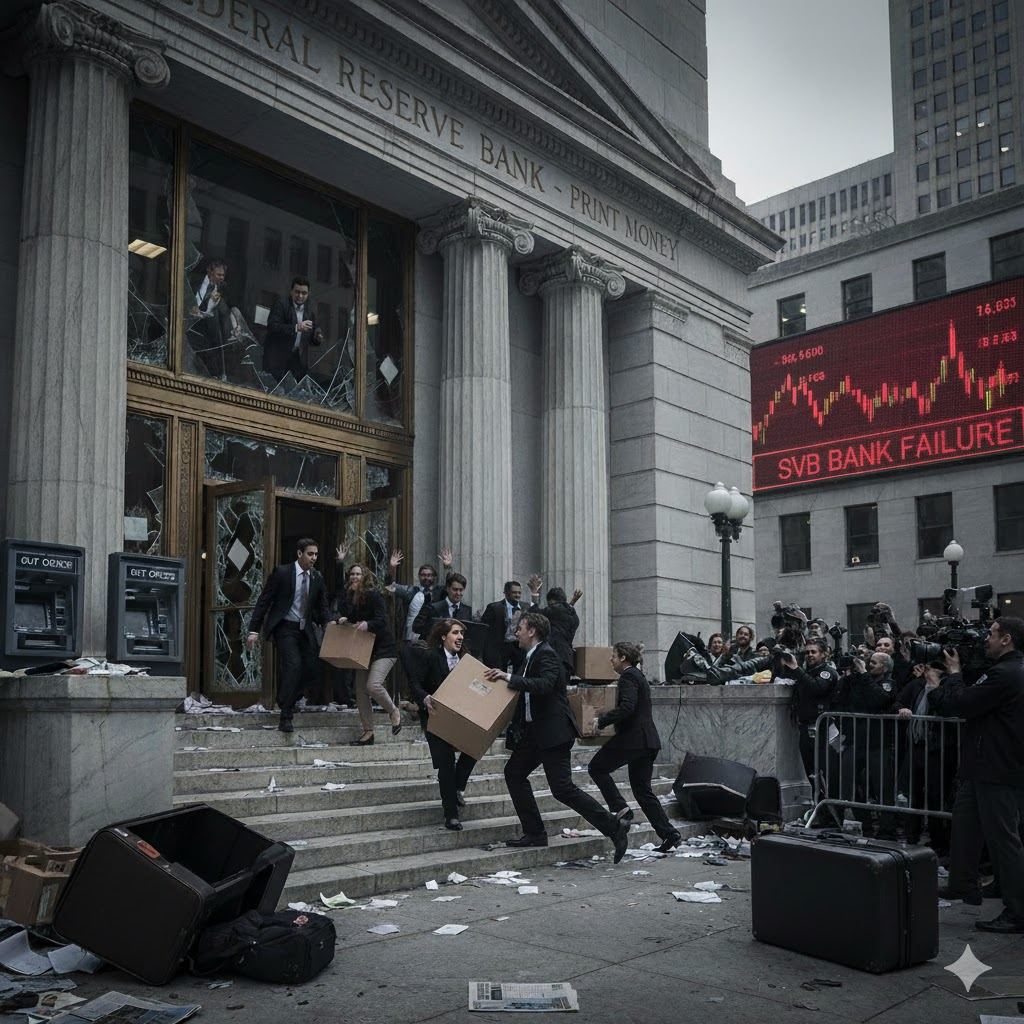
In Spring 2023, the illusion of “risk-free” bonds shattered. The regional banking crisis— led by the collapse of Silicon Valley Bank— wasn’t caused by reckless speculation, but by losses on U.S. Treasury bonds. When interest rates rose, the value of those bonds plunged, and the banks holding them broke. The Federal Reserve was forced to create an emergency lending program (the BTFP) that allowed banks to borrow against those bonds at full face value, even though the bonds were deeply underwater.
A safe-haven or risk-free asset should not be capable of threatening the entire financial system. And surely, a “safe” asset should not require the government to rewrite its valuation rules just to keep the system from collapsing. This intervention sends a clear signal: the supply of U.S. debt has grown so large that the private market alone is unable or unwilling to absorb it without demanding cripplingly high interest rates.
Devaluation is the Current Risk- Default of the Dollar is the Future Risk
The defense of the "safest investment" claim is always built on a technicality: nearly zero default risk. This “zero default” argument only stands at this time because the U.S. government can print the currency in which it borrows, so they claim it can never technically fail to make a payment. Centuries of history prove this only works for a matter of time until it doesn’t.
However, this technical “safety” ignores the real risk being actively introduced by the Fed's actions:
Inflation: The loss of the purchasing power of your dollar.
At this time, Washington can print the money to pay its debts, but it will never be able to print value. Every new dollar created dilutes the one you already saved. Inflation is just the visible symptom of this silent theft.
And while you hold bonds that "promise a fixed payment", the real value of those dollar payments shrinks every year.
The truth is that the debt market is floating not on investor confidence, but on the purchasing power of the central bank. Without the Fed as the government's largest, most essential customer, the U.S. bond market would face a severe reckoning— proving that its "risk-free" status is a carefully managed illusion.
Why Gold is the Answer
As the illusion of safety in bonds unravels, a deeper truth emerges: when the foundation of the world’s “risk-free” asset depends on artificial demand, it ceases to be a true hedge against crisis. Bonds were once considered the ultimate stabilizer in a portfolio— assets that rose when markets fell. But history proves that when inflation surges, bonds fall, stripping investors of their supposed protection. In moments like these, only one asset has stood firm through every era of monetary distortion: GOLD.
Since the U.S. abandoned the gold standard in 1971, we see Gold has outperformed the S&P, DOW, and Treasuries:
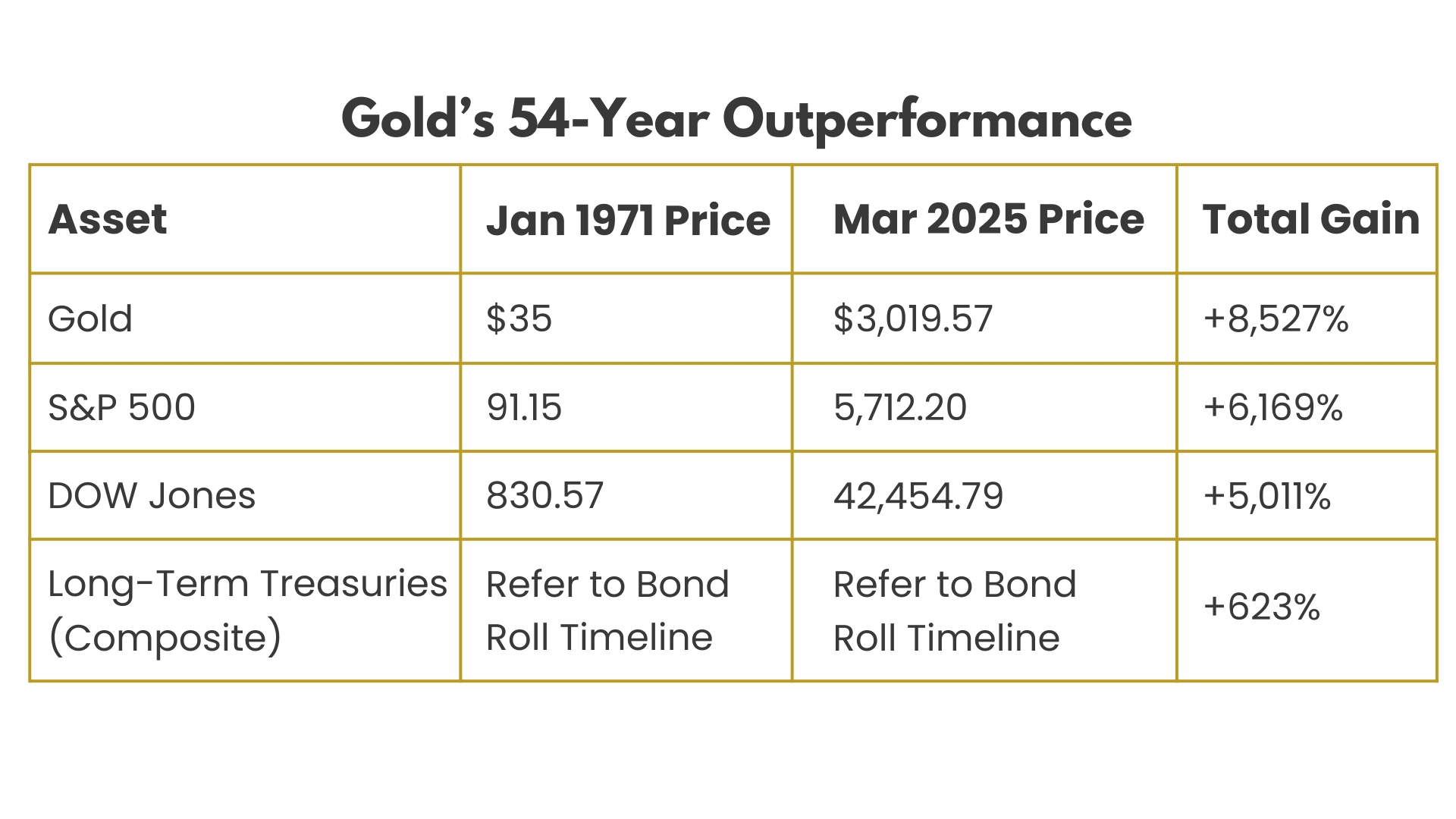
Note: 30-year Treasury bonds were not available in 1971.
Updated Treasury Bond Methodology (Through Jan, 1 2026)
Treasury Bonds
(Long-Term Hold-to-Maturity Model)
To estimate long-term bond performance, this model assumes a buy-and-hold strategy, with interest and principal rolled into each successive bond. No price trading or mark-to-market volatility is included — consistent with how bonds are typically presented in 60/40 portfolio models.
Bond Roll Timeline
January 1971: Purchase a 20-year Treasury bond at 6.5%
January 1991: Roll proceeds into a 30-year Treasury bond at 6.5%
January 2021: Roll proceeds into a 30-year Treasury bond at 1.65%
Held through January 2026 Total nominal profit (1971–Jan 2026): ≈ +635%
Re-Weighting the Portfolio: 60/20/20 to Add 20% Gold and Minus 20% of Bonds
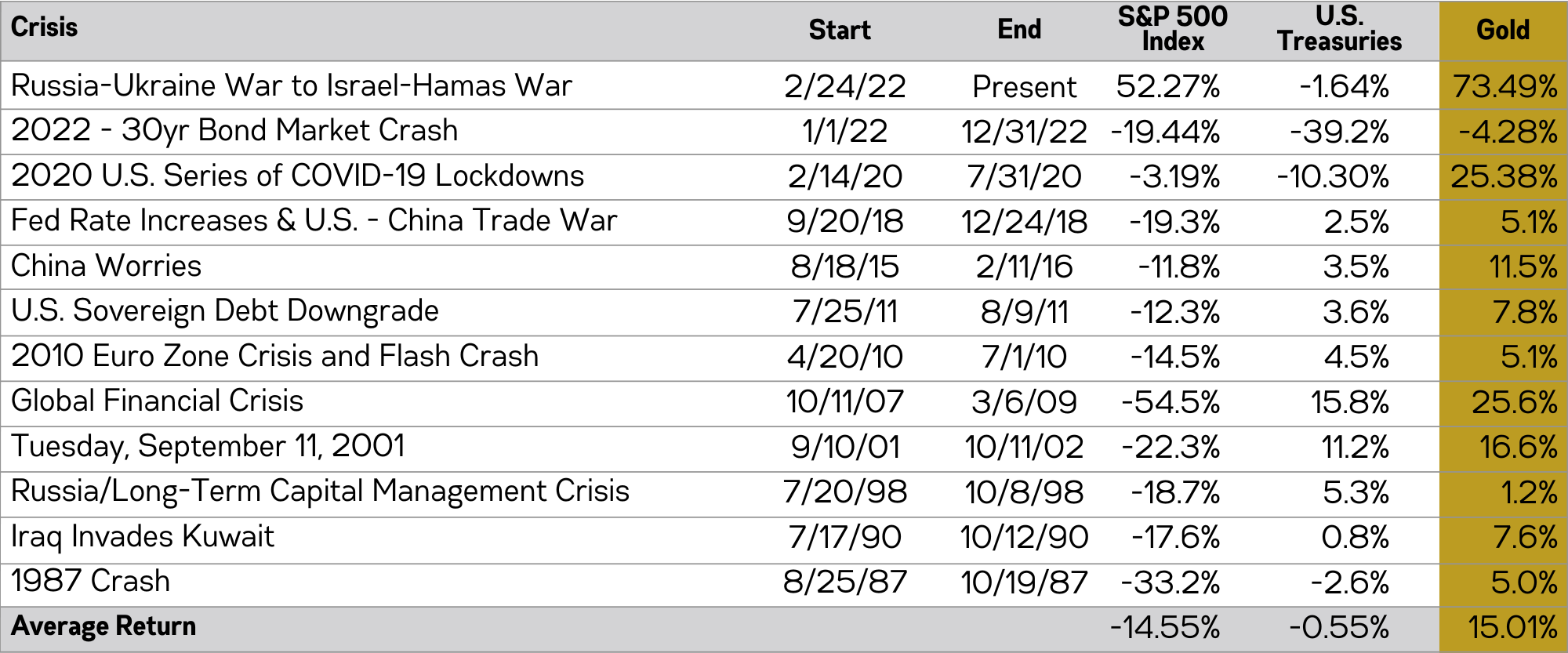
Gold— often dismissed as a “non-yielding” asset— has, in fact, outperformed both major stock indexes and long-term bonds throughout the entire fiat-money era. Even during the S&P 500’s strongest decades, gold surged in the inflationary 1970s, preserved wealth during the dot-com collapse, outperformed through the 2008–2012 financial crisis, and again during the 2020 COVID crisis.
If we model a 54-year portfolio comparison:
- Traditional 60/40 (Equities/Bonds)
Weighted Return ≈ (0.60 × 6,169%) + (0.40 × 623%) = ≈3,719% - Gold-Augmented 60/20/20 (Equities/Physical Gold/Bonds)
Nominal Return ≈ (0.20 × 12,250%) + (0.20 × 635%) + (0.60 × 7,410%) = ≈7,025%
Gold shows a 49% higher compounded nominal return
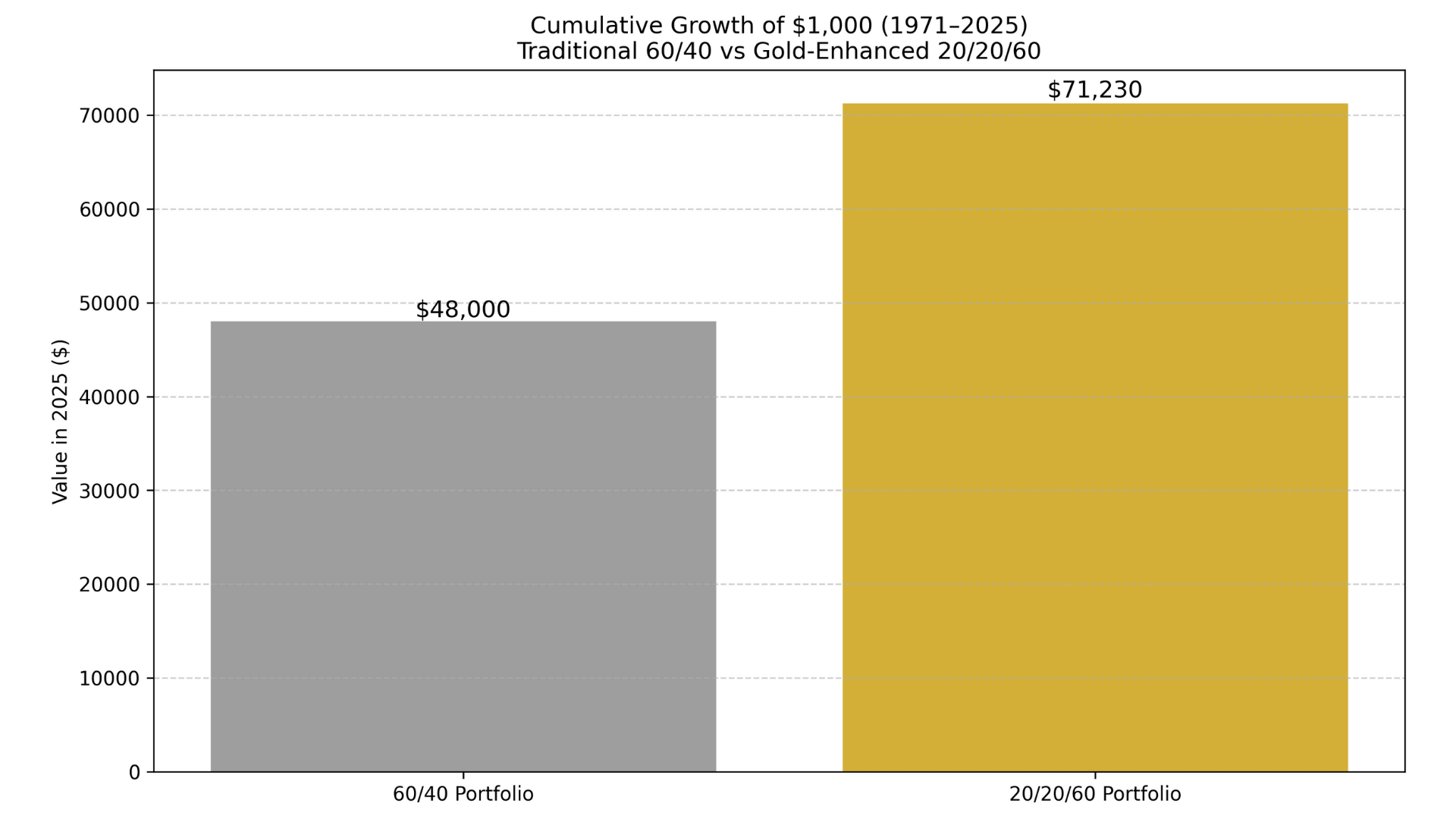
That’s a 49% higher compounded nominal return than the 60/40 model — while historically reducing volatility in every inflationary cycle.
Why Gold Makes The Difference
- Inverse Correlation to Bonds and Stocks – Gold historically rises during equity drawdowns and inflation shocks. Bonds, in contrast, lose value when inflation and rates rise simultaneously.
- Real Asset, Not a Promise – Bonds rely on governments to maintain purchasing power; gold is purchasing power.
- Liquidity in Crisis – Gold remains globally tradable when currencies, sovereign debt, or banking systems lose trust.
- Central Bank Validation – Global central banks have been net buyers of gold every year since 2010 — signaling where true “reserve” confidence lies.
Conclusion
Had an individual allocated just 20% to gold since 1971, (When the U.S. abandoned the gold standard) the portfolio would have:
✅ Outperformed the traditional 60/40 model by roughly 49%,
✅ Endured less correlation risk, and
✅ Preserved real purchasing power across six major inflationary and recessionary periods.
In an age where governments rely on perpetual debt expansion, a “balanced” portfolio without physical gold is no balance at all.
The 60/20/20 model isn’t speculation — it is TRUE protection

When Safety Is Engineered, True Protection Must Be Chosen
In today’s financial system, safety is no longer organic— it’s manufactured. The same policies that hold the bond market together are the very ones eroding the purchasing power of the dollar that those bonds are paid in. Every rate cut, every new round of quantitative easing, and every fiscal bailout may buy time, but it also deepens dependency and accelerates the devaluation of paper assets. That is why the world’s most sophisticated institutions— from global central banks to sovereign wealth funds— continue to quietly accumulate gold. They understand what most people forget: gold is not a speculation; it’s insurance against the failure of paper promises.
When the next crisis hits, the question won’t be whether the Fed intervenes— it will be how much more the currency must be sacrificed to preserve the illusion of stability. In that moment, those who hold physical gold will not be waiting for reassurance from the central bank. They will already own the one asset that stands outside the system, immune to default, devaluation, and deceit.
The Case for Physical Gold During Times of Crisis
The Harvard Gold
Group Difference
Your Trusted Gold IRA Company
Harvard Gold Group (HGG) holds an A+ rating with the BBB and holds 5-star ratings on all major review sites.
HGG is the first gold dealer in America to provide customers the more “expensive" specialty coins at the same low range cost we offer for bullion coins. Don’t pay more for numismatic, semi numismatic, or collector coins.
We do not employ commissioned salespeople or bonused managers— ensuring that your goals, not sales quotas, are always our top priority.
Clients benefit from free consultations, transparent costs, and metals overviews, lifetime account support for you and your heirs— along with a simple, hassle-free buyback program.
Clients also enjoy direct assistance from HGGs co-owners who, since 2010, have helped Americans move over $100 million into tangible gold and silver, whether for secure direct delivery or retirement accounts / Precious Metals IRAs.