
Bond Market

Why Gold Fell Below $4,000 Even as Central Banks Continued Buying

Gold briefly fell below $4,000 per ounce last week, reaching its lowest level since July. Silver declined even more sharply.  That movement may seem surprising to some people. Inflation remains elevated, the federal deficit is nearly $2 trillion, central banks continue purchasing gold, and geopolitical uncertainty remains high.  However, gold never responds to just one

Why Gold Fell Below $4,000 Even as Central Banks Continued Buying Read More »

Why Rising Debt Could Fuel One of Gold’s Strongest Decades

Gold does not have to rise every week for the reasons to own it to grow stronger.  At Harvard Gold Group, we believe the current decline in gold prices is providing a good buying opportunity for people looking to add physical gold to their retirement savings. The price has pulled back, but the larger concerns

Why Rising Debt Could Fuel One of Gold’s Strongest Decades Read More »

America’s Debt Problem Is Bigger Than the Next Fed Move: Gold Is Telling the Truth

The Federal Reserve can raise rates to fight inflation. But it cannot fix federal spending, erase the nation’s debt or make the government’s refinancing needs disappear. That is why some professional investors believe gold is increasingly reflecting a much larger fiscal problem. KEY TAKEAWAYS  Inflation remains above the Federal Reserve’s 2% goal, prompting the Fed

America’s Debt Problem Is Bigger Than the Next Fed Move: Gold Is Telling the Truth Read More »

The Bond Market Just Flashed a Warning — and Gold Deserves the Spotlight

The Bond Market Just Flashed a Warning — and Gold Deserves the Spotlight 

Row wavy Shape Decorative svg added to top Key Takeaways  The bond market recently acted in an unusual way: Treasury yields climbed even as oil prices fell, signaling that inflation fears and rate concerns may be deeper than one headline. Bonds are supposed to be the “safe” side of a traditional portfolio, but recent volatility

The Bond Market Just Flashed a Warning — and Gold Deserves the Spotlight  Read More »

FX Market Time Bomb

The Overlooked FX Market Time Bomb: Leverage, Liquidity Strains, Dollar Funding Pressures, Massive Volatility, and Global Spillover Risks The global foreign exchange (FX) market is enormous— it is where currencies are traded— is the world’s largest and most liquid financial market, with average daily turnover reaching $9.6 trillion as of April 2025 (per the Bank

FX Market Time Bomb Read More »

20/20/60 image

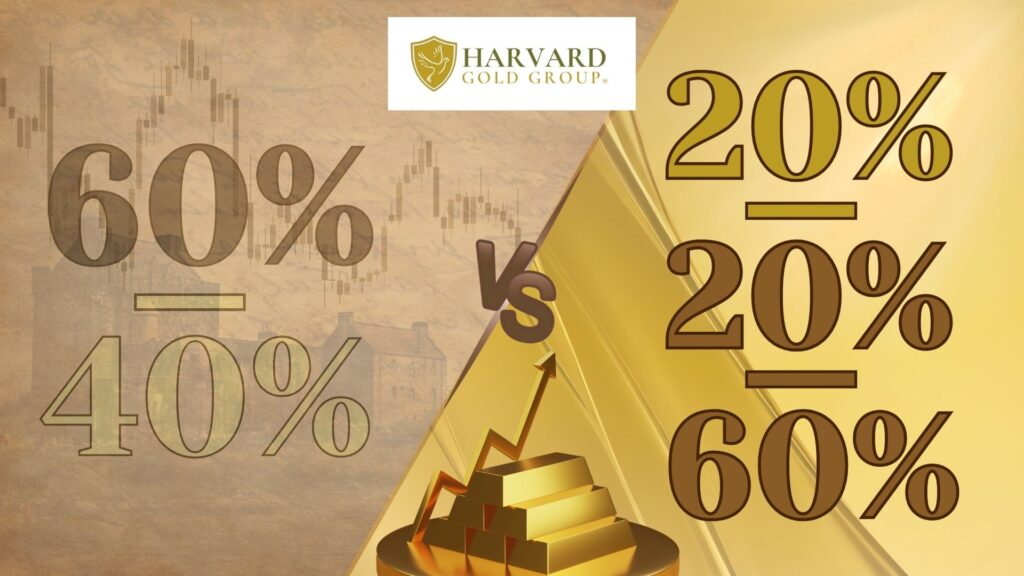
Diversification 60/20/20 – Stocks/Gold/Bonds vs Standard 60/40 Portfolio

Since the U.S. abandoned the gold standard in 1971, we see Gold has outperformed the S&P, DOW, and Treasuries: For this article, we are using March 2025 gold price of $3,019.57. Given gold’s historic run in 2025, we wanted to keep this article’s charts conservative. Doing so leaves room for the pullbacks and rebounds that

Diversification 60/20/20 – Stocks/Gold/Bonds vs Standard 60/40 Portfolio Read More »

The Global Repo Market is Facing Serious Risks Right Now  

Hidden cracks in the global financial “plumbing” — especially the massive repo market — are building serious risks right now.  The repo market (short-term loans backed by government bonds) is like the short-term borrowing system that keeps big money flowing smoothly in finance. Big players — banks, hedge funds, investors — borrow cash overnight by putting up

The Global Repo Market is Facing Serious Risks Right Now   Read More »

The Bond Market is Walking a Tightrope 

Sovereign Bond Markets: Sovereign bond markets are not simply another part of the investment universe— they are the foundation of the global financial system.. The United States is the world’s largest bond issuer, and in 2026 it must refinance trillions of dollars of debt that was originally sold during the near-zero-rate pandemic era. That matters

The Bond Market is Walking a Tightrope  Read More »

Bonds — Once Safe Havens — Are Now Prone to Flash Crashes 

And What That Means for Investors Seeking Stability  For decades, government bonds were considered the ultimate safe-haven asset. When stocks fell, investors were taught to move into bonds for protection, stability, and preservation of capital. U.S. Treasuries and other sovereign bonds were viewed as shock absorbers for portfolios. But today, that long-standing belief is being

Bonds — Once Safe Havens — Are Now Prone to Flash Crashes  Read More »

Scroll to Top