
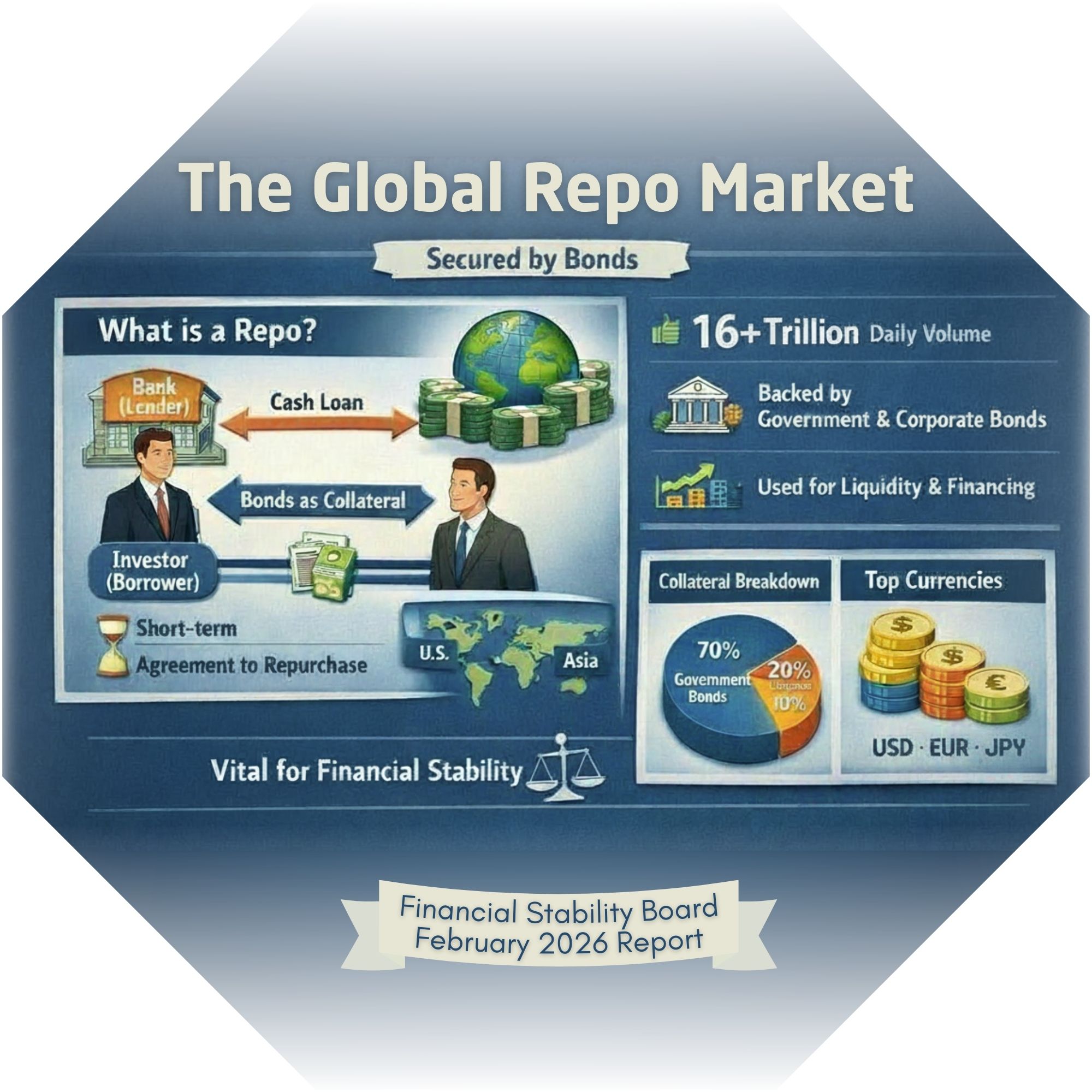
Hidden cracks in the global financial "plumbing" — especially the massive repo market — are building serious risks right now.
The repo market (short-term loans backed by government bonds) is like the short-term borrowing system that keeps big money flowing smoothly in finance. Big players — banks, hedge funds, investors — borrow cash overnight by putting up safe government bonds (like U.S. Treasuries) as collateral, then buy them back later.
A key February 2026 report from the Financial Stability Board (FSB), the global financial watchdog, spotlighted deep vulnerabilities in these government bond-backed repo markets. Here's the breakdown in everyday terms:
- The market is enormous: About $16 trillion in these loans were outstanding at the end of 2024 — roughly 80% of all repo activity worldwide.
- It's grown fast: Up around 20% since 2022, fueled heavily by hedge funds ramping up their borrowing (leverage) to make bigger bets.
- Super concentrated: The U.S. handles nearly 60% of it, with the UK, euro area, and Japan making up most of the rest.
- Why it's risky right now: These markets are vital for everyday liquidity (keeping cash available), but they can freeze or amplify chaos during stress. Key red flags from the FSB include:
1. Limited backup from a handful of big dealers — bottlenecks can form quickly. And BlackRock, Morgan Stanley, and JP Morgan have cut way back. 2.High leverage — especially among hedge funds — means small price drops can force massive selling.3.
Heavy dependence on overnight/short-term funding — if lenders suddenly say "no more," borrowers scramble for cash. Bonds are dumped, spilling the crisis over to the bond market like in 2022.4.
In about 70% of non-cleared trades have any protection if things go wrong.
In a crunch (like past crises in 2020 or 2022), lenders pull back, borrowers dump bonds in "fire sales," prices crash further, and stress spreads to government bonds and the whole system — turning hidden plumbing problems into major floods.
The Financial Stability Board (FSB) calls this a systemic threat because repo markets enable leverage buildup, quick imbalances in demand/supply, and high concentrations that could disrupt everything. It's one of the big reasons financial watchers are on high alert in 2026.