
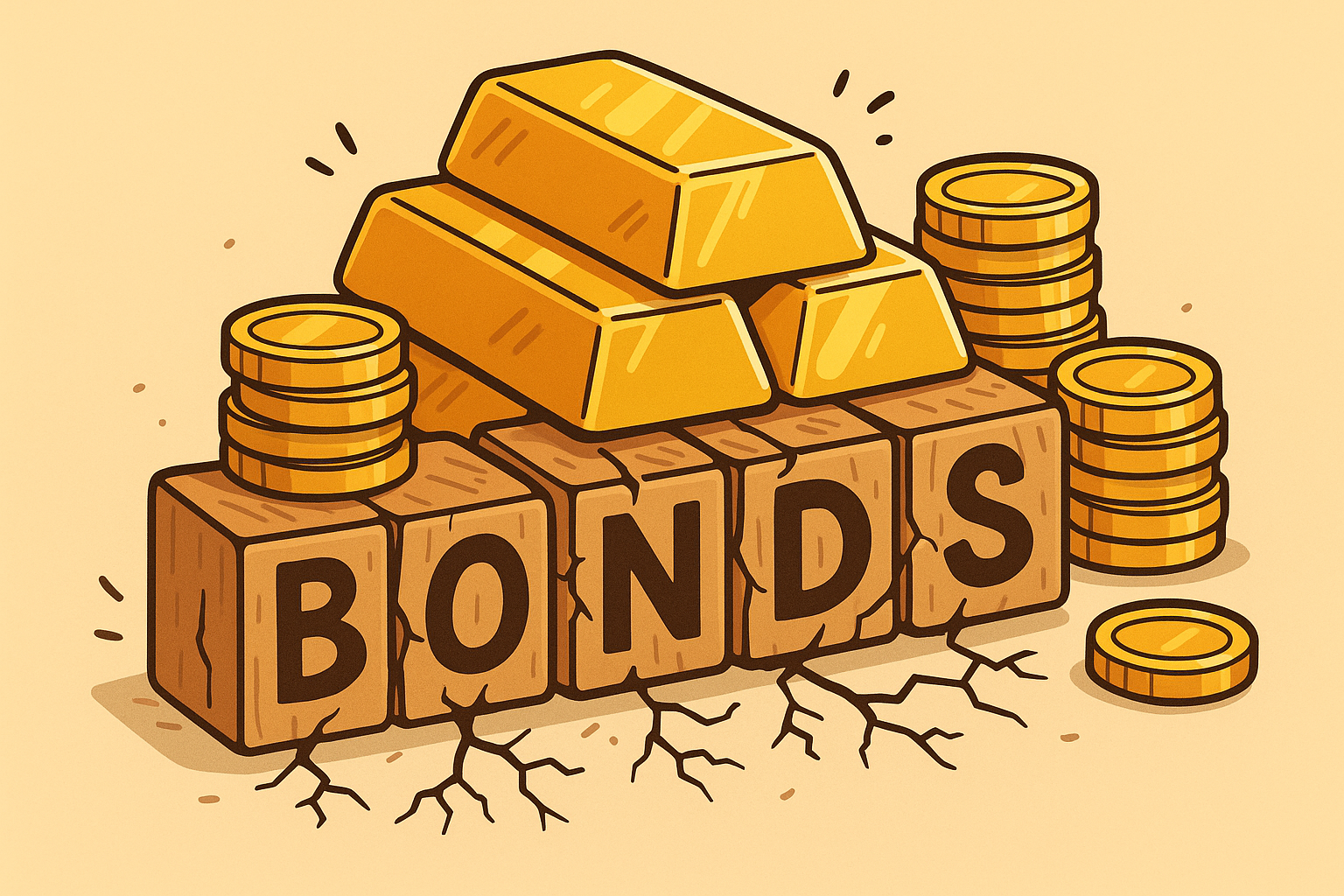
The government bond markets in the U.S., Japan, and the U.K. are all showing strain at once. This rare alignment underscores the challenges facing global debt markets and highlights why many investors are rethinking the idea that bonds are always “safe.”
Bonds Are No Longer the Shelter They Once Were
Traditionally, government bonds were viewed as a reliable hedge—stable, income-producing, and low risk. But since 2020, bonds have suffered some of the worst drawdowns in modern history.
- U.S. Treasuries have endured back-to-back years of losses, something not seen in decades.
- Gilts (UK bonds) saw their steepest selloff since the 2022 pension crisis.
- Japanese government bonds are now testing multi-decade highs in yields as the Bank of Japan steps back from ultra-easy policy.
In short: bondholders are learning that when debt loads surge, inflation lingers, and central banks retreat, bonds are no longer a guaranteed safety net.
Why Bond Markets Are Struggling
- Rising Supply: Governments are issuing record amounts of new debt to cover ballooning deficits.
- Weaker Demand: Investors are demanding higher yields before committing to long-dated debt.
- Policy Shifts: Central banks (Fed, BOJ, BOE) are pulling back from bond buying, leaving the market to absorb more risk.
- Sticky Inflation: Even with interest rates higher, inflation isn’t yet tamed—pressuring real returns on bonds.
These pressures have pushed yields higher, eroding the value of existing bonds and rattling markets worldwide.
Gold’s Resilient Outperformance
While bondholders have faced sharp losses, gold has delivered the opposite story:
- Since January 2020, gold has climbed from about $1,500 per ounce to over $3,300 per ounce in August 2025—a gain of more than 120%.
- Gold has outpaced stocks, bonds, and cash, reinforcing its role as a store of value during periods of debt stress, inflation, and geopolitical tension.
- Unlike bonds, gold isn’t tied to government deficits or interest-rate maneuvers—it’s tangible, finite, and globally recognized.
What This Means for Retirement Savers
Investors relying heavily on bonds for “safety” may need to reconsider. The bond market’s struggles since 2020 prove that government debt is not immune to volatility. In contrast, gold has held—and increased—its purchasing power.
For those approaching or in retirement, diversifying with physical gold and silver in a self-directed IRA or through direct delivery can provide:
- A hedge against inflation and debt risk
- Tangible protection outside the banking system
- Stability when traditional “safe havens” falter
The Bottom Line
- The bond markets in the U.S., Japan, and the U.K. are sending warning signals that debt risks and policy shifts are reshaping the investment landscape. For investors who want to protect their savings from volatility, gold has already proven to be the stronger safe haven since 2020—and continues to shine when bonds do not.
Harvard Gold Group
We are here to help you explore your options with:
- Gold & Silver IRAs (tax-advantaged, penalty-free transfers and rollovers)
- Direct Delivery of Precious Metals (shipped securely to your home or depository)
- Free Investor Guides & Consultations
📞 Call (844) 977-4653 or visit www.harvardgoldgroup.com to learn how you can protect your retirement today.
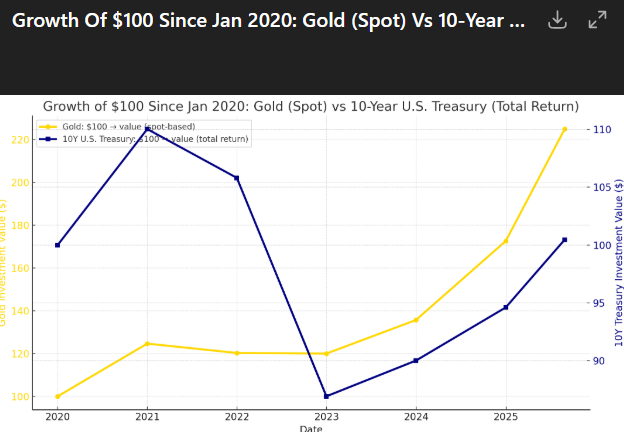
Here you go — a clean, apples-to-apples comparison of $100 invested on Jan 1, 2020:
- Gold (spot-based prices): $100 grows in proportion to spot from $1,520.55 → $3,420, i.e., more than a 2.2× gain.
- 10-Year U.S. Treasuries (total return): $100 compounded using annual 10-yr Treasury total returns for 2020–2024 (Damodaran), plus 2025 YTD via IEF as a transparent proxy. Bonds are underwater.
Download the chart:
gold_vs_10ytreasury_2020_to_2025YTD.png
Download the data (for compliance/records):
gold_vs_10ytreasury_2020_to_2025YTD_values.csv
Sources
- 10-Year U.S. Treasury total returns (annual 2020–2024): Prof. Aswath Damodaran, NYU Stern — “Historical Returns on Stocks, Bonds, Bills” (10-year T-bond total return series). FRED
- 2025 YTD Treasury proxy: IEF (iShares 7–10 Year Treasury Bond ETF) YTD total return ≈ 6.18% (late Aug 2025). Yahoo Finance
More About the 3 Major Bond Markets:
US, Japan, and UK Bond Markets Are Flashing Red—Here’s What’s Driving the Stress
Government bond markets in the U.S., Japan, and the U.K. are all showing strain at once—a rare alignment that’s sending a global warning about inflation, supply, and policy risks.
The big picture
Fresh debt supply is ramping back up into the fall while inflation proves sticky and central banks weigh their next steps. Long-dated yields have pushed higher across advanced economies, pressuring governments’ borrowing costs and unsettling investors after a bruising summer. Recent coverage highlights renewed turbulence as major economies prepare more long-maturity issuance and as auction demand shows signs of softening. Reuters
United States: Supply Indigestion and Fragile Auctions
In the U.S., several recent Treasury auctions have shown weaker demand metrics (e.g., softer bid-to-cover and small “tails”), a sign investors require more compensation to hold duration amid heavy issuance and policy uncertainty. Analysts flagged a weak mid-month auction and a noticeable “tail,” meaning the government paid a higher yield than indicated just before the sale. FXStreet
Bond-market nerves were also jolted by an abrupt, futures-led yield spike in early August—interpreted by some desks as a large hedge or even a trading error—underscoring brittle liquidity conditions. Reuters
While the much-watched U.S. yield curve has been slowly steepening, policymakers and investors remain attuned to its message for growth: historically, curve inversions precede slowdowns, and regional Fed research continues to track this as a recession risk gauge. MorningstarCleveland Federal Reserve
Why it matters: With deficits elevated, the Treasury’s financing needs stay heavy into year-end. Any wobble in auction demand or renewed inflation surprise could push term premiums—and long yields—higher.
Japan: The End of Ultra-Easy Policy is Colliding with Debt Math
Japan’s long-end yields have surged to multi-decade highs in 2025 as markets test how far the Bank of Japan will let rates rise after exiting its decade-long ultra-easy regime. Thirty-year JGBs around mid-year breached 3%—levels not seen since the 1990s—while the government itself warned about rising yields and shifting demand as the BOJ trims its footprint. Yahoo FinanceReuters
More recently, BOJ board commentary has emphasized rising uncertainties—from wage dynamics to tariff policy spillovers—keeping the door open to additional tightening if inflation risks persist. Markets are pricing the possibility of another rate hike this year. Reuters+1
Why it matters: Japan’s public debt load is enormous, and “natural buyers” for long JGBs are evolving. If the BOJ steps back further while issuance remains heavy, volatility at the long end can spill over to global duration. Aberdeen Investments
United Kingdom: Gilt Fragility and Balance-Sheet Runoff Rethink
The gilt market has endured episodes of sharp selling this summer, with 10-year yields briefly jumping the most since the 2022 LDI crisis as investors fretted over the fiscal outlook. Reuters
Officials have already shown sensitivity to liquidity. In April, the Bank of England postponed a long-dated sale “in light of recent market volatility,” and this month it warned that ongoing quantitative-tightening gilt sales—especially at the long end—risk amplifying market strains, hinting QT may need to slow. ReutersBloomberg.com
Why it matters: The U.K. still faces sticky-ish inflation prints and heavy refinancing needs. If the BOE tempers QT to avoid market dislocations, that would underline how tight the balance is between policy normalization and market functioning. BlackRock
Common Threads Across All Three
- More supply coming: Governments are issuing more long-dated paper into a market still adjusting to higher rates and smaller central-bank balance sheets. That combination has kept volatility elevated. Reuters
- Auction quality under scrutiny: Soft bid-to-covers and tails (U.S.), lackluster long-end demand (Europe, Japan) suggest investors want higher term compensation. ReutersFXStreet
- Policy uncertainty: From BOJ rate-path ambiguity and tariff risks to the BOE’s QT pacing and questions about U.S. policy credibility, investors are demanding more yield to bear duration risk. Reuters+1Bloomberg.com
Disclaimer: Harvard Gold Group is not a financial advisor. This content is for informational purposes only. Investors should consult with their financial and tax professionals before making investment decisions. Past performance is not indicative of future results.