
Inflation— How to Protect Against Its Ravaging Effects
Inflation isn’t just an economic statistic— it’s a hidden tax that silently robs every American every single day… without ever passing a law or sending you a bill. Unlike the income tax deducted from your paycheck, this “stealth tax” is unvoted on, unavoidable, and devastating.
Every trip to the grocery store or gas station proves the point: the same dollar buys less. For retirees, savers, and people on fixed incomes, the impact is brutal.
This report doesn’t just explain what causes inflation or highlight the best assets against it. It exposes the hidden triggers that fuel dangerous super bubbles across markets. When these bubbles burst—bringing recessions and financial crises like the 2008 Great Recession—401(k)s can shrink into “201(k)s,” and housing values can collapse. Without proper hedging, it’s a double whammy.
Inflation is built into the system, and currency devaluation has repeated itself for centuries. This report breaks "inflation" down with easy-to-understand information, charts, and examples. With understanding comes the ability to outmaneuver inflation and even build wealth in the middle of it.
Since it is well known that (hard assets) real estate and physical gold have been the top two assets to outperform inflation, we will lay out their key differences so you can decide which is best for you—or perhaps both belong in your strategy.
Cost of Living— Largest Challenge American's Face
A recent Public Opinion survey from June to July 2025 revealed that the cost of living is the single largest challenge Americans are facing and worrying about. Source: StatistaChart_PublicOpinion
Government inflation reports may show modest percentages, but they no longer capture the real pain points Americans are facing. While grocery and gas prices have eased slightly from their peaks, the biggest burdens remain: soaring utility bills, homeowners’ insurance, property taxes, and healthcare costs— both premiums and out-of-pocket expenses. Families are being squeezed, forced to cut back on essentials, drain savings, or rely on credit cards just to stay afloat.
The numbers confirm the strain. According to the Fed’s Household Debt and Credit Report (Q1 2024), serious delinquencies on credit card balances—90+ days past due—hit 10.7% —nearly matching the all-time high of 11.0% during the 2008 Great Recession. And this is without an officially declared recession. If delinquencies are already this high now, what happens when the next recession or financial crisis arrives? newyorkfed.org/microeconomics
How to Protect When Budgets are Stretched
Real-Estate? Gold?
With household budgets stretched and debt climbing, the question becomes: how can Americans protect their wealth when the next downturn hits?
Historically, hard assets like real estate and physical gold have been the very best long-term mitigator against inflation. But when economic stress hits, their paths sharply diverge. In the 2008 financial crisis, credit markets froze—loans were nearly impossible to secure unless you didn’t need one. Real estate values collapsed, leaving homeowners unable to tap equity. Gold, however, did the opposite: it climbed in value, fulfilling its role as a safe-haven asset.
Gold also holds a decisive edge in liquidity. Property can take months to sell, and access to equity often disappears in recessions when banks tighten lending. Gold, by contrast, is universally liquid—tradable virtually anywhere in the world, at any time.
On top of that, it carries far fewer ongoing costs. Unlike real estate, there are no annual property taxes, insurance premiums, or costly maintenance bills. At most, investors who use secure depository storage may pay modest storage fees—yet even then, gold’s flexibility and resilience in times of crisis make it a stronger safeguard and a critical tool for portfolio diversification.
Purchasing Power of the Dollar vs. Gold
The most important reason to diversify your wealth with gold is the declining purchasing power of the U.S. dollar. Over time, the dollar’s value has eroded significantly due to inflation—primarily driven by excessive money creation (money printing) and debt expansion, which we will explain next. These two forces are deeply interconnected. Historically, all fiat (paper) currencies have eventually failed due to inflation, leading to currency resets or radical shifts in monetary policy.
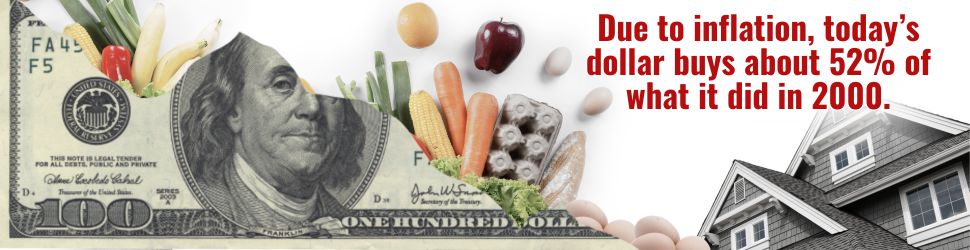
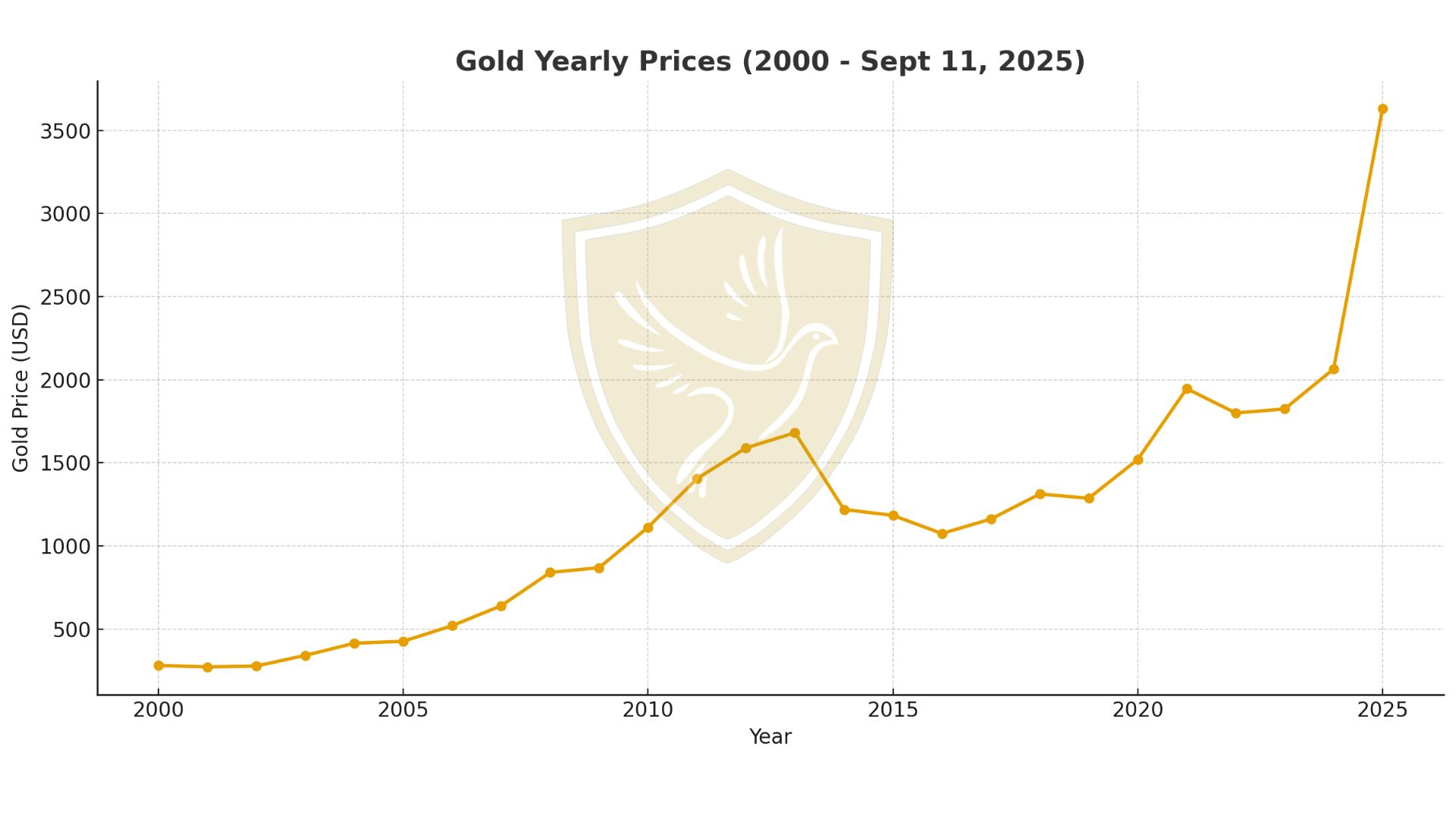
Since 2000, the dollar has lost nearly half its value—today it buys only about 52% of what it did then. Gold, on the other hand, has surged from $282.05 in January 2000 to $3,630 as of September 11, 2025. That’s a compound annual growth rate (CAGR) of 10.8%, consistently outpacing inflation and building people's wealth!
Why Inflation Persists
Inflation isn’t an accident — it’s built into the system. Economists and historians agree: inflation is first and foremost a monetary phenomenon. It happens when the supply of money — whether printed bills or easy credit — grows faster than the economy’s ability to produce goods and services. You then have too much money chasing too few goods, pushing prices higher. When politicians pile on astronomical government spending — from trillion-dollar stimulus handouts to endless bailouts, each dollar in your pocket loses value.
But the story doesn’t end there. Government actions, particularly interest rate manipulation and overregulation (in the wrong areas), pour gasoline on the fire. When governments cut interest rates too far, for too long, they create artificial demand in industries reliant on lending — housing, automobiles, commercial real estate — inflating prices far beyond what a healthy market would sustain.
And when they combine cheap credit with aggressive money printing and massive fiscal spending, you get something far worse: the “super bubbles” which we are still seeing from the 2020 pandemic.
The Two Primary Causes of Inflation
1. Money Printing and Credit Expansion
The first driver, money printing, is straightforward: when governments flood the economy with new currency, the value of every existing dollar is diluted. History offers painful reminders: Weimar Germany, Zimbabwe, Venezuela. People literally needed wheelbarrows of cash for a loaf of bread.
In today’s world, what fuels inflation even more is the tidal wave of credit expansion. Through fractional-reserve banking, financial institutions can lend far more than they actually hold. Mortgages, car loans, credit cards, and business credit all create new money. And with every loan, more money is injected into the system — pushing prices higher.
It isn’t only households and businesses borrowing — government debt plays a massive role too. As of August 12, 2025, U.S. debt has climbed past $37 trillion. The government now pays about $1 trillion a year in interest — money it borrows just to cover the payments. This cycle is called a debt spiral: borrowing more to pay old debt. Each new round of borrowing puts more money into the system, driving up inflation and weakening the dollar.
This cycle has repeated for centuries. And it explains why the very same governments and central banks that endlessly expand debt and print money also hoard physical gold. Gold is the historically proven stable asset in the face of paper currency devaluation.
2. Government Intervention in the Marketplace
While money printing is relatively easy to spot, government-created inflation often hides in plain sight. It doesn’t look like “inflation policy” — it’s marketed as protection, fairness, or stability. But the result is the same: higher prices and fewer choices for consumers.
Key ways governments fuel inflation include:
- Government Indebtedness – Overspending leads to higher taxes and new fees: sales tax, food tax, gasoline tax, property tax, and even new licensing requirements. An indebted government guarantees more future inflation.
- Selling Rights & Freedoms to Big Business – Licenses and permits create monopolies. Small entrepreneurs are locked out unless they pay enormous upfront costs, protecting entrenched corporations and allowing them to raise prices unchecked.
- Import Tariffs – Tariffs act as hidden taxes, letting domestic producers hike prices while reducing consumer choice.
- Price Controls – Historically disastrous, they lead to shortages, black markets, and even higher eventual prices.
Step back and you see the pattern: the more Washington interferes, the more your dollar suffers.
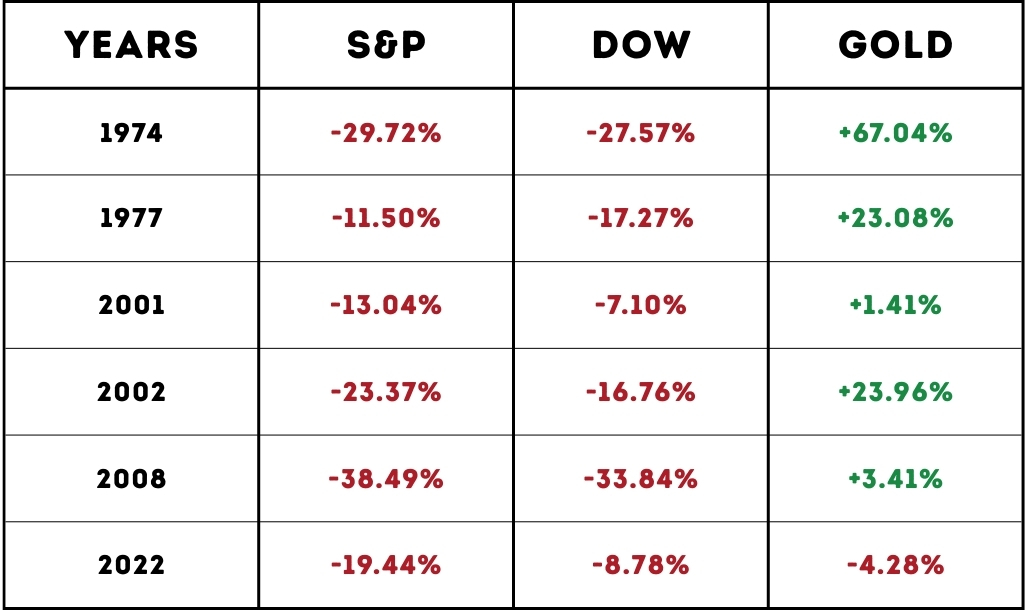
If you step back and look at the past 25 years, a clear pattern emerges: each economic crisis has been larger than the one before. The 2001 Dot-Com bubble was followed by the 2008 Great Recession catastrophe, and then by the unprecedented scale of the 2020 pandemic crisis and response. With each downturn, the government has intervened more aggressively — unleashing greater money printing, heavier manipulation of monetary policy, and deeper interest rate cuts to keep the house of cards standing. This escalation has not solved the underlying problems; it has only set the stage for even larger bubbles and more severe corrections.

Worst years in the Stock Market since the US came off the gold standard in 1971
Why Gold is Different
Unlike the dollar, gold isn’t just a promise on paper — it’s real money.
It carries no debt obligation, no politician can “print” more of it, and no central bank can erase its value. Even the Dutch National Bank admitted: “In Gold We Trust. We are preparing for Armageddon.”
History proves the point. During the inflationary 1970s, gold soared tenfold while traditional investments stagnated. Today, Washington and Wall Street may dismiss gold as “just a commodity,” but their actions tell another story: central banks are buying more gold than at any time in history. As of June 2025, physical gold even surpassed the euro as the world’s second-largest reserve asset held by central banks.
They know what’s coming.
Beyond Inflation: The Fed Can't Step Back
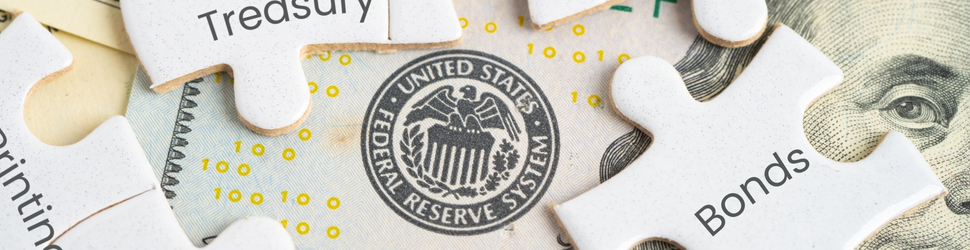
Unlike money printing or credit expansion, the Fed uses another tool that doesn’t spark inflation immediately — but virtually guarantees it later: bond market manipulation.
Washington’s addiction to spending means it must constantly sell new bonds to cover massive deficits. When demand falters, the Fed steps in — buying Treasuries and mortgage-backed securities to artificially suppress rates and prop up markets.
By spring 2022, years of aggressive bond-buying had swollen the Fed’s balance sheet to $9 trillion. The “unwind” began that June, but by March 2025, reality hit: bond supply surged, yields spiked, and stocks tumbled. The balance sheet had only slimmed to $6.7 trillion — barely $2.3 trillion off its peak. Within weeks, the Fed slowed the unwind and hinted at stopping altogether.
The problem? Markets can no longer stand on their own. Every round of intervention inflates bigger bubbles — and every bubble eventually ends in a bigger crash.
This cycle — manipulation → delayed correction → bigger crash → more inflationary policy — is why we now experience larger but shorter recessions. Each one more severe and followed by more inflation… leading us closer to what some call a “Super Crash” that will eventually trigger a monetary currency-reset cycle.
Super Crash Coming: Pandemic “Super Bubble”
The 2020 pandemic response combined the worst of both worlds: easy money and heavy-handed intervention. Central banks slashed rates to near zero, flooding the economy with cheap credit. Governments printed record sums to fund stimulus checks, forgivable loans, and corporate bailouts — while lockdowns choked supply chains and limited the flow of goods.
The result was predictable: too much money chasing too few goods. Inflation spiked to levels not seen in decades, and the so-called “Super Bubble” was born. Now, with stock markets and housing still near record highs — and Washington spending with no restraint — this bubble looks less like a boom and more like the setup for a super crash.
How to Protect Your Wealth
Periods of high inflation always reward tangible assets — things you can hold, that don’t depend on political promises. The most time-tested are:
- Gold — the world’s true reserve currency.
- Energy resources like oil and gas.
- Agriculture and farmland.
- Certain real estate.
Gold stands apart: it’s the only asset trusted across centuries, nations, and crises.
Inflation is not slowing down. It’s not “temporary.” It’s the playbook. Each cycle ends the same way — with a weaker dollar and ordinary Americans paying the price.
That’s why it’s time to stop treating gold as an afterthought and start treating it as what it truly is: the ultimate diversifier against a broken system.
A Complete Guide to Gold & Silver
Discover the Benefits of Precious Metals in Your Savings & Retirement
All submissions agree to the risk disclosure + privacy policy. We respect your privacy & will not sell your information. Unsubscribe anytime.
*Any information provided is for general informational purposes only and does not constitute legal, tax, accounting, or investment advice.*
The Harvard Gold
Group Difference
Your Trusted Gold IRA Company
Harvard Gold Group (HGG) holds an A+ rating with the BBB and holds 5-star ratings on all major review sites.
HGG is the first gold dealer in America to provide customers the more “expensive" specialty coins at the same low range cost we offer for bullion coins. Don’t pay more for numismatic, semi numismatic, or collector coins.
We do not employ commissioned salespeople or bonused managers— ensuring that your goals, not sales quotas, are always our top priority.
Clients benefit from free consultations, transparent costs, and metals overviews, lifetime account support for you and your heirs— along with a simple, hassle-free buyback program.
Clients also enjoy direct assistance from HGGs co-owners who, since 2010, have helped Americans move over $100 million into tangible gold and silver, whether for secure direct delivery or retirement accounts / Precious Metals IRAs.